SCHEDULE A FREE EXAMINATION!
+387 51 230 700
 WORK TIME
Monday - Friday
-
08:00 - 20:00
Saturday
-
09:00 - 13:00
Sunday
-
Day off
Address
-
Vidovdanska 2, Banja Luka
CONTACT
Mob:
+387 65 233 88 (VIBER)
Tel:
+387 51 230 700
Tel:
+387 51 230 701
E-mail:
ordinacija@simicdent.com


MENI
- Home
- Services
- ESTHETIC DENTISTRY
- DENTAL PROSTHETICS
- PERIODONTIC
- ORAL SURGERY
- CONSERVATIVE DENTISTRY AND ENDODONTICS
- PEDIATRIC AND PREVENTIVE DENTISTRY
- ORTHODONTICS
- HYALURONIC TREATMENT
- LASER THERAPY
- OZONE THERAPY
- DIGITAL DENTAL X-RAY (RTG)
- Straumann implant placement. A quick and painless routine procedure with an experienced oral surgeon - implantologist - Banja Luka
- Subperiosteal implants
- Team
Gallery
- Dental tourism
- News
- Contact
-
 English


 Eng
SCHEDULE A EXAMINATION!
+387 51 230 700
WORK TIME
Monday - Friday
08:00 - 20:00
Saturday
09:00 - 13:00
Sunday
Day off
Address:
Vidovdanska 2, Banja Luka
 CONTACT
Mob:
+387 65 233 888 (VIBER)
Tel:
Tel:
E-mail:
 MAKE AN APPOINTMENT!
DENTAL PROSTHETICS
Dental prosthetics represent one of the most important branches of modern dentistry, as they allow patients to replace missing teeth, restore the natural aesthetics of their smile, normal chewing function, and confidence in everyday communication.
At Simić Dent clinic, located in the center of Banja Luka, we craft prosthetic restorations with the highest precision in our in-house digital laboratory, using modern technology, top-quality materials, and a personalized approach to every patient.
Our goal is not only to bring back your smile, but to make it long-lasting, natural, and functional.

Production of metal-ceramic crowns and bridges

Dental bridges and crowns, also known as “caps,” are considered fixed prosthetic restorations, which means they are permanently cemented onto previously prepared teeth and cannot be removed.
Crowns are used when a natural tooth is damaged, weakened, or aesthetically unacceptable, while bridges are used to replace one or more missing teeth, relying on adjacent healthy teeth as supports.
These restorations not only fully restore chewing function but also offer high aesthetic results. The adaptation period is usually very short, and patients quickly perceive them as a natural part of their body.
Crowns extend the lifespan of teeth when conservative treatment is no longer possible, while precisely crafted bridges ensure a stable bite and even distribution of chewing forces.
The process begins with a detailed examination and planning, followed by tooth preparation (grinding), digital impression taking, placement of temporary crowns, laboratory fabrication, fitting, and final cementation.
The base of a metal-ceramic crown is a strong metal cap covered with layers of high-quality ceramic, ensuring both durability and a natural appearance.
With proper oral hygiene and regular check-ups, such prosthetic restorations can last from seven to ten years, or even longer, providing a stable and long-lasting solution for numerous functional and aesthetic issues.
Production of non-metal crowns and bridges
Following modern trends, and thanks to the fabrication of metal-free crowns and bridges in our own dental laboratory, we can fully meet the highest global standards of esthetic dentistry.
Crowns and bridges made from zirconia, ceramics, or a combination of the two possess the translucency of natural teeth, which no other prosthetic material can match. Moreover, unlike metal-ceramic crowns where a gray line may appear along the gum margin over time due to gum recession, this does not occur with metal-free crowns. On the contrary, thanks to the exceptional biocompatibility of the material, the gingiva naturally adapts to the edge of the crown, filling any gaps and creating a perfect transition between tooth and gum.
Metal-free ceramics do not cause allergic reactions or irritation, making them an ideal choice even for patients with sensitive systems.
In addition to outstanding esthetic results, these restorations are long-lasting, as ceramic retains its color, shine, and stability even after years of wear.
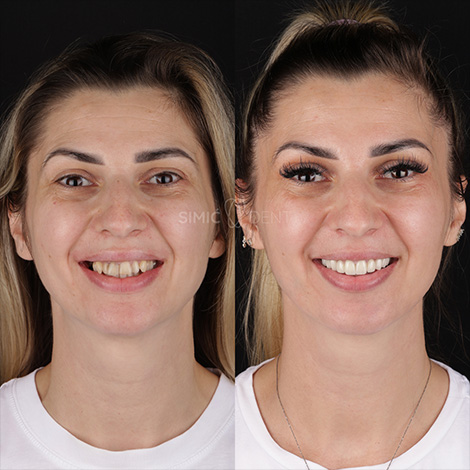
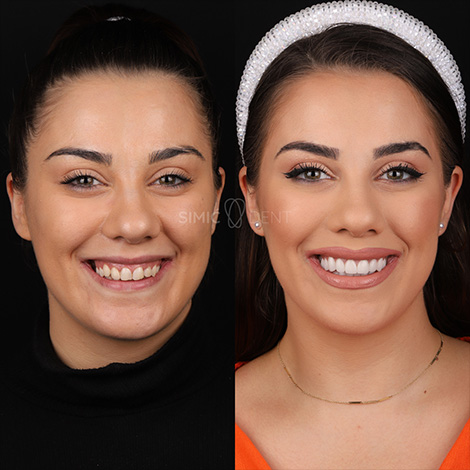
Your smile will gain a more youthful appearance, and your entire face will look fresher, more rested, and more expressive.
Production of combined prosthesis
Sometimes, it is not possible to create a high-quality fixed restoration due to an insufficient number or unsuitable position of the remaining teeth.
If there are contraindications for implant placement, and the number of remaining teeth is not enough for a fixed solution, it is possible to create a combined prosthetic restoration, which provides satisfactory aesthetics and function while preserving the existing teeth.
A combined prosthetic work consists of a bridge fixed to your natural teeth and a skeletal (removable) denture that replaces the missing teeth, connected to the fixed part using precision attachments or clasps.
This type of restoration offers better stability and comfort compared to conventional partial dentures, as it distributes chewing forces more evenly and reduces pressure on the mucosa and gums. Aesthetically, a combined solution looks much more natural, as it does not includevisible metal elements.
It also allows for easy removal and cleaning of the removable part, simplifying oral hygiene and extending the lifespan of both the prosthesis and the remaining teeth.
Total dentures
Modern dentistry is based on prevention, with the ultimate goal of preserving teeth, their function, and aesthetics. The loss of all teeth brings various complications.
First and foremost, chewing becomes impossible, which impairs normal digestion and leads to numerous gastrointestinal issues, affecting overall health. Breathing also becomes more difficult. The disruption of jaw alignment, which accompanies tooth loss, leads to changes in the temporomandibular joint—often resulting in pain, clicking, and limited mouth opening.
Aesthetics are seriously compromised in edentulous patients—the lower third of the face shortens, the corners of the mouth turn downward, and nasolabial folds deepen, giving the face an older, tired, and sad expression.
In addition to health and aesthetic concerns, it has been proven that tooth loss also causes psychological issues—from social withdrawal and avoidance of contact to the development of anxiety and depression.
Complete edentulism directly affects a patient’s quality of life, self-confidence, and emotional well-being. The fabrication of a complete denture requires knowledge, experience, and above all, the dedication of both the dentist and dental technician to reconstruct the full shape of the jaws, establish proper bite alignment and facial aesthetics, and help the patient adapt to the new prosthesis.
With an individualized approach and careful execution of each phase, modern full dentures can provide reliable stability, good functionality, and satisfying esthetic results—restoring not only the patient’s smile, but also their dignity.
All on 4, All on 5, All on 6
All-on-4 is a modern implant-prosthetic procedure used to treat complete tooth loss. It involves placing a fixed zirconia bridge reinforced with titanium on four implants.
All-on-6 is the same procedure but with six implants—the additional two implants increase the longevity and stability, making this concept ideal for younger patients or those with weaker bone structure.
All-on-5 is less commonly used and serves as a middle ground between All-on-4 and All-on-6, often chosen by patients with moderately good bone density who want extra stability.
Why choose the “ALL ON X” solution?
1. Fast and minimally invasive procedureThe All-on-X concept is popular among patients because it allows the placement of a temporary fixed bridge the same day or within 24 hours after implantation.
The implant procedure usually takes about 2 hours per jaw, followed by the installation of the temporary bridge a few hours later.
2. Bone augmentation is usually not needed
Thanks to the expertise of implantologists and a well-planned implant positioning system, bone grafting or additional procedures like sinus lift are most often unnecessary.
3. Stability and aestheticsFixed implant bridges provide excellent stability and can last for decades, especially when made from high-quality materials like zirconia.
Aesthetically, depending on the color and shape, they resemble natural teeth and do not give the appearance of toothlessness.
The All-on-X concept is more affordable than older methods using 8 or more implants. The procedure is shorter, less expensive, and the results are outstanding.
Šta je stomatološka protetika?
Dental prosthetics deals with the replacement of one, several, or all missing teeth in the jaw, as well as the aesthetic and functional rehabilitation of teeth that are damaged, worn, discolored, or misshapen. The goal is to restore proper chewing, speaking, and smile aesthetics, as well as to harmonize the face by establishing correct interjaw relationships.
Prosthetics includes:
1. Fixed restorations – crowns, bridges, veneers, and lumineers
2. Removable restorations – full and partial dentures
3. Combined work – combining fixed and removable solutions
4. Implant-supported restorations – crowns, bridges, and dentures supported by dental implants, including All-on-4 and All-on-6 concepts, as well as restorations on subperiosteal implants.
Ceramic veneers
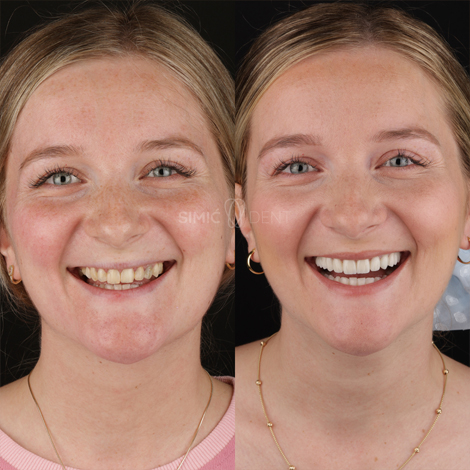
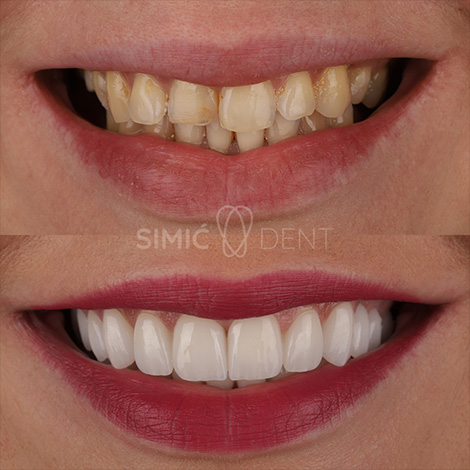
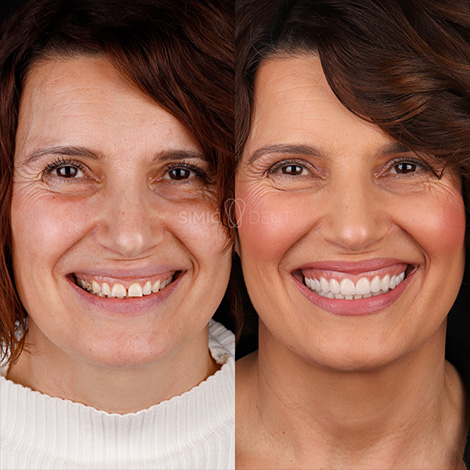
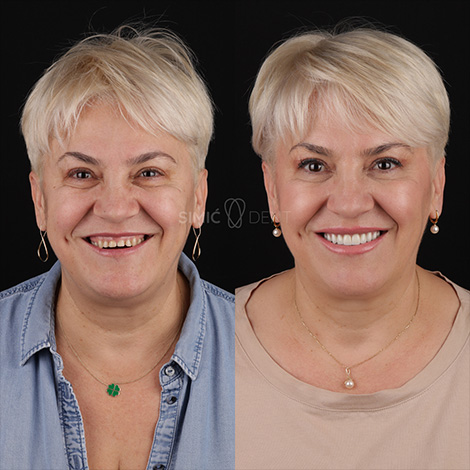
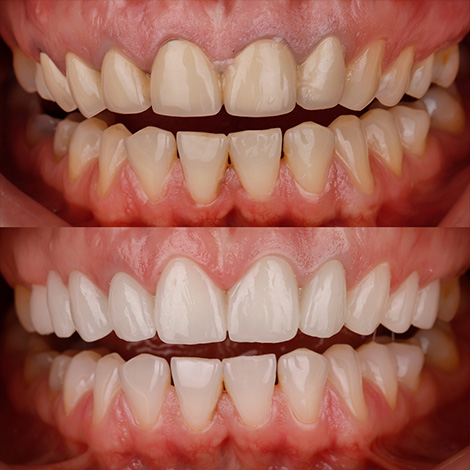
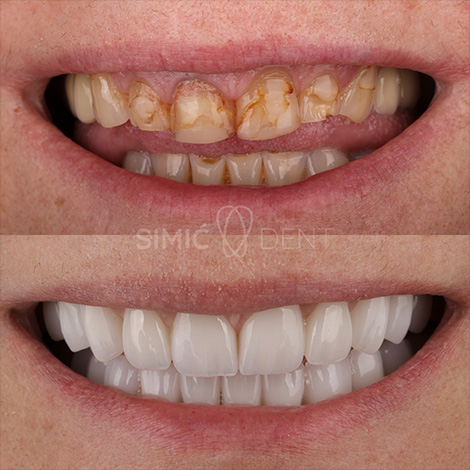
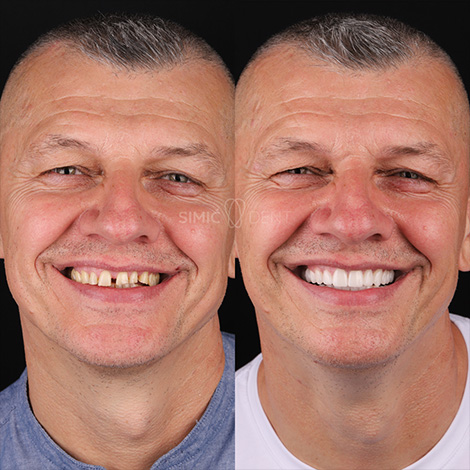
Veneers, or ceramic shells, are one of the most sought-after services in dental prosthetics. Whether it’s a slightly misaligned tooth or discoloration, these esthetic imperfections can be corrected with the use of ceramic veneers, which provide outstanding esthetic results.
Based on a model made from the patient’s dental impression, ceramic or zirconia veneers are designed with the help of a computer, which not only ensures the highest measurement precision, but also injects the ceramic, allowing for maximum accuracy in shaping the veneers.
Veneers actually replace the natural enamel of the tooth, allowing correction of tooth color, removal of pigmentations that do not respond to whitening, and minor corrections in position, size, and overall appearance of the teeth.
Thanks to their high translucency and light reflection, ceramic veneers perfectly mimic the natural look of teeth and are almost indistinguishable from real ones.
In addition to their outstanding aesthetics, veneers (ceramic shells) are also highly resistant to discoloration, and with proper oral hygiene, they can last over 10 years. They are ideal for patients who want a long-lasting, highly aesthetic result without invasive dental procedures.
This is a perfect combination of minimal invasiveness and maximum aesthetic effect. However, to determine whether a patient is a suitable candidate for veneers, a detailed examination is required, including bite analysis and jaw movement assessment.